How long do well-resoled climbing shoes last (real workshop data)
How long a climbing shoe resole lasts, how many times you can resole them and why two identical pairs last differently. Data from 40+ years in the workshop.
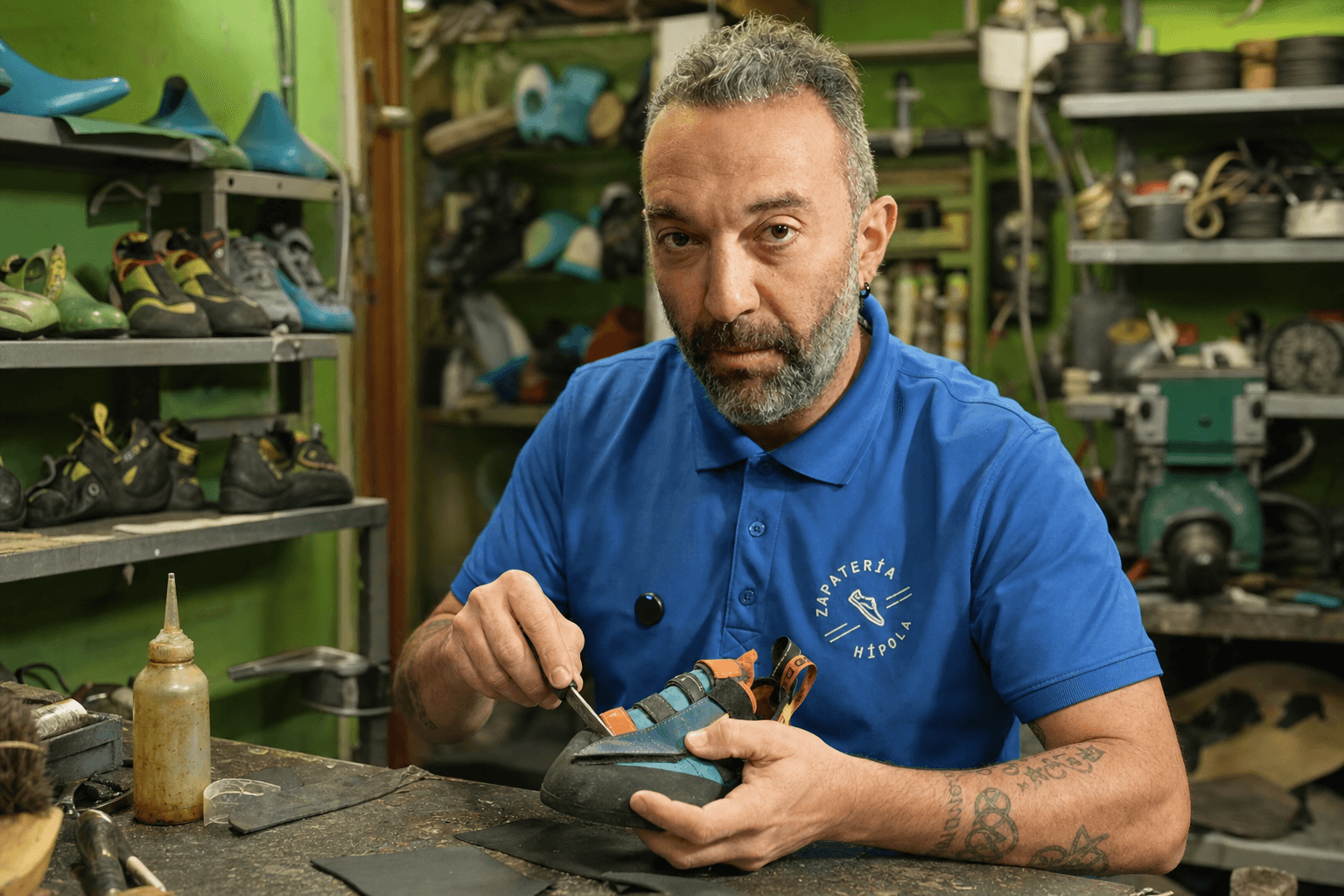
It's the question climbers who come through the workshop ask us most: how long is this resole going to last? The honest answer is: it depends. But after 40+ years putting rubber on climbing shoes, we have some fairly reliable ranges that we'll explain below.
Average service life by discipline
Bouldering and hard sport (8a+ and up): a good resole with Five Ten Stealth HF or La Sportiva FriXion RS rubber lasts between 30 and 60 climbing sessions before it asks for the next one. The more technical the climbing (more use of the edge and the toe), the sooner it wears out.
Moderate sport (6c-8a): 50-90 sessions. The pressure on the edge is lower and the rubber tread keeps its shape longer.
Trad and multi-pitch: 100-150 sessions. Slab and crack climbing generates less abrasion than bouldering.
Indoor (climbing gym): 80-120 sessions. Plastic holds are less abrasive than natural rock, but the frequency of use tends to be higher.
How many times they can be resoled before binning them
Under normal conditions, a well-treated pair of climbing shoes will take 3 or 4 resoles before the midsole, the edge or the shoe's own construction calls it a day.
The limiting factor is almost never the rubber: it's the midsole (the layer that sits between the foot and the outer rubber). When it deforms or breaks, the resole loses precision and it's no longer worth it.
Another factor is the edge. If on the first resole you only asked for sole rubber and by the third you're asking for a new edge, sole and toe-cap reinforcement, you're paying almost as much as a new pair.
Why two identical pairs last different amounts of time
We've seen the same La Sportiva Solution on two customers last 30 sessions for one and 80 for the other. The variables that explain that difference:
How you place your foot: someone who climbs with an aggressive toe-down stance and lateral loading wears out the edge in 3 sessions. Someone who climbs more gently lasts twice as long.
Which wall you climb: polished limestone in Patones is kinder than Pedriza quartzite. Rough granite destroys rubber quickly.
Whether you air them out or not: shoes that live inside a closed bag build up moisture → the rubber loses elasticity sooner. After every session, get them out into the light.
The rubber compound: Five Ten HF (high friction) grips more but wears out faster. C4 lasts longer but demands more effort.
Signs it's time to resole
1. You feel the edge going blunt when you pinch onto a small hold — you start slipping where you used to stick.
2. You can see the inner midsole poking through in the area of the big toe. If you wait any longer, you'll damage the midsole and the resole gets more complicated.
3. The sole rubber has visible holes or has cracked.
4. It sounds different when it strikes a hold: hard/dry rubber has a drier sound than new rubber.
What we do in the workshop
A full resole with Five Ten Stealth (HF, C4 or Onyxx to your preference) or La Sportiva FriXion in actual stock. A new precision edge when needed. Bonding with a lifetime guarantee. If the resole doesn't recover precision because of a deformed midsole, we'll tell you before charging you.
Price from €45. A fixed quote via WhatsApp after seeing photos.