Motorcycle boots: what can be fixed
Torn lugs, a worn sole, broken buckles or a split zip: what gets repaired on motorcycle boots, what gets replaced and how long the workshop takes.
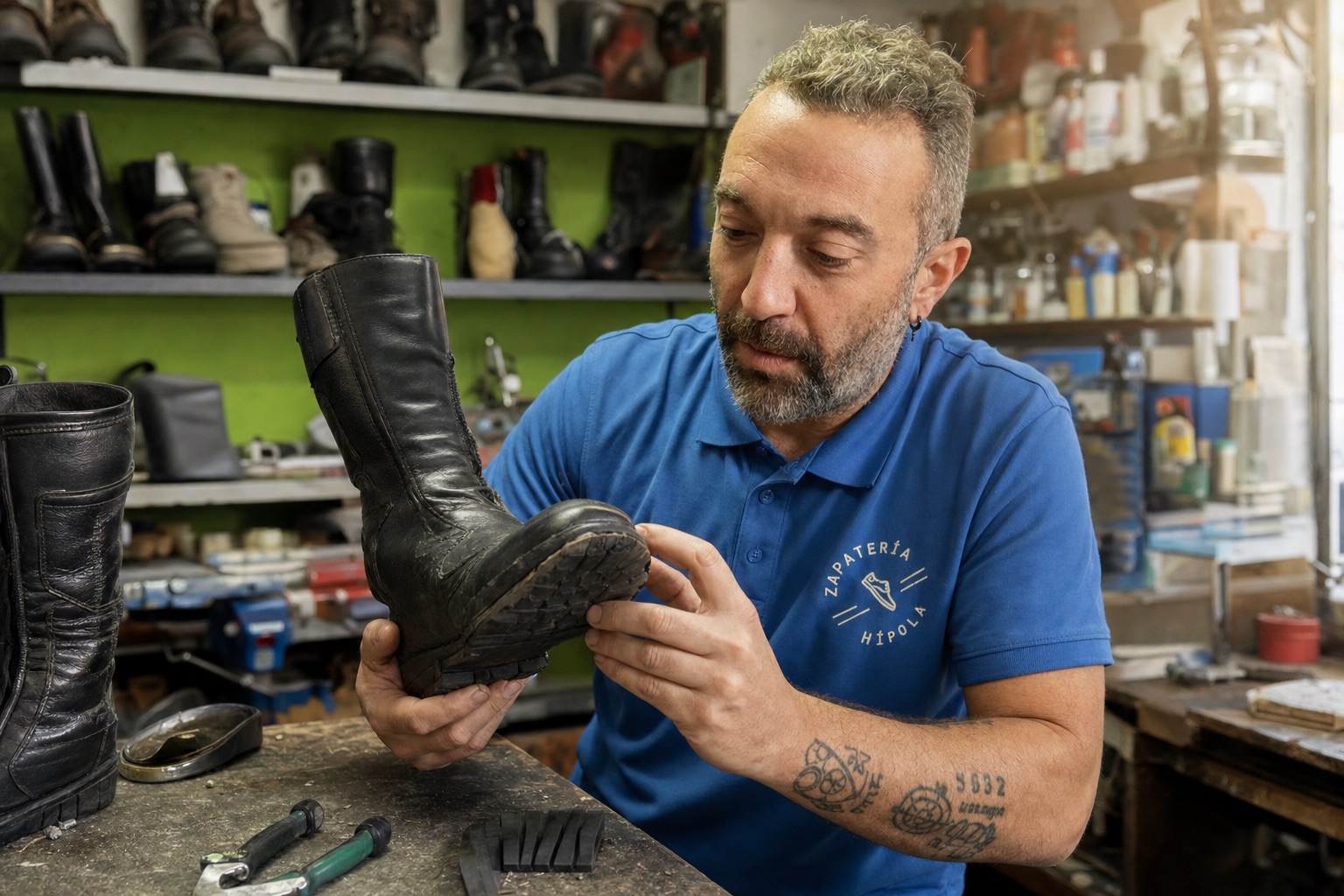
You buy motorcycle boots once and wear them out in very specific places: the lugs, the gear-shift area, the buckles and the zip. They rarely fail all at once, and that is the good news: what fails is usually the part, not the boot.
This guide explains what gets repaired, what gets replaced and how the workshop decides. If you already know what you need, the breakdown by discipline and the price list are on motorcycle boot repair.
Start by looking at two things separately
The sole and the upper are two different repairs and they are decided separately. The sole is what you walk on and what wears out first; the upper is the leather, the stitching and the hardware.
A boot with a healthy upper and a destroyed sole is the most rewarding repair that comes through the door. The other way round, when the leather has cracked where it flexes or the seams have opened in several places, the job stops being a sole and becomes something else: that needs a photo before anyone promises anything.
Torn lugs or a worn sole
The question here is not whether it can be fixed, but how much fixing it needs. It depends on the state of the sole block, not on how many lugs are missing.
If the block is structurally sound, lugs are bonded back one by one with Pegafort and technical rubber equivalent to the original. If the structure is broken, it is not patched: the whole sole is replaced, and every resoling job is heat-sealed.
Off-road we fit Andes outsoles (Fighter, La Bestia or Challenge, depending on whether you ride enduro, motocross or trial) from €68. On the road, Vibram Motorbike; and for track riding, the Slider with protections. Which one is yours depends on where you ride, and that is broken down on the motorcycle page.
Buckles, straps and zips
Buckles are replaced individually, rivet included, for €25 to €40 depending on the boot model. If all four need replacing, the workshop quotes the set as a whole rather than adding them up one by one.
The zip is where repairing and replacing get confused the most. If the teeth are deformed, no repair will hold: the whole zip is replaced. If the problem is the slider or a loosened base, it gets reinforced and carries on working. The difference shows with the boot in hand, and you are told before anything is touched.
The gear-shift area
This is the wear everyone recognises: the instep of the left boot scuffed bare from shifting up. That area is handled with instep and heel reinforcements, and with metal toe caps from €25 when the boot calls for them.
The sooner it comes in, the less work it takes. Once the rubbing has gone past the outer layer and reached the structure, it is no longer a reinforcement: it is a rebuild.
How long it takes
A full repair takes 10 to 15 working days, and what sets the pace is not the workshop: it is whether the specific part for your model is available.
If you ride enduro or compete, tell us the date when you ask for the quote. With a date on the table you get priority; without one, it goes in the queue.
If you don't live in Madrid
You don't need to come to the workshop. Nationwide pick-up starts at €18: we collect at your address, the boots come into the workshop and go back repaired.
It is the same route the clubs outside Madrid use, and nothing changes about the quote: it is closed beforehand on WhatsApp, exactly as if you had brought them in yourself.
What to send for a quote
One photo is enough to tell what the boot needs. If you can, shoot the sole from the side, because that is where you see whether the block will take a bond or needs a new sole.
And tell us two more things: the boot model and what you use it for, off-road or road. With that we can name the exact outsole and give you a closed price, usually in under an hour.