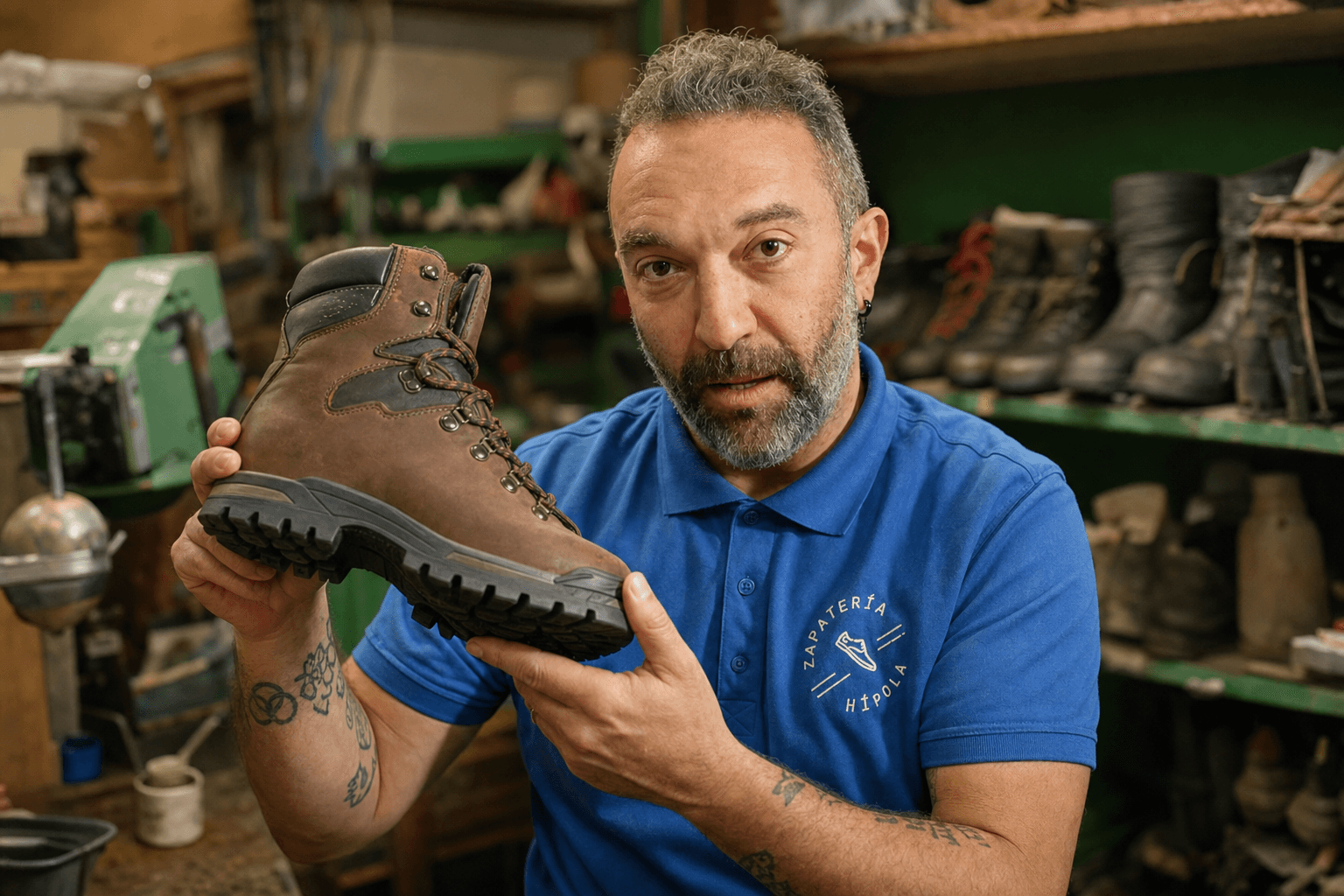
Resole your mountain boots or buy new ones
A full Vibram resole costs €65 and a decent new pair costs between €150 and €300. When each option pays off, and which part of the boot actually decides it.
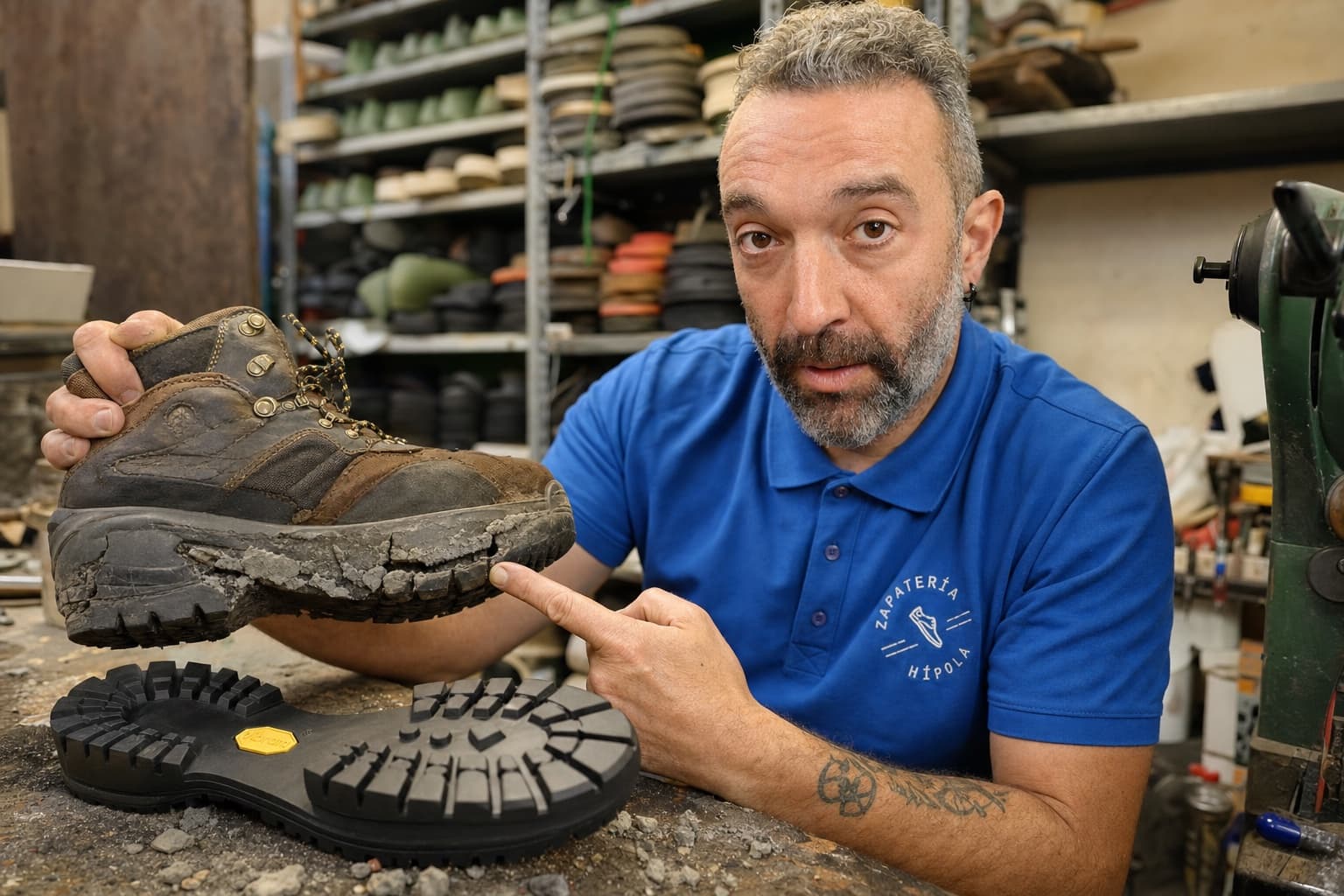
October comes round, you pull the boots down for the first walk of the season and find a bald outsole, a rand peeling off at the toe or, worse, a midsole crumbling like dry sand. If you already know what you need, here is the price list for resoling mountain boots.
If you don't, this is the question we get most on WhatsApp: do I spend €65 on a resole or buy another pair? The honest answer is that it comes down to one single part of the boot, and it isn't the outsole.
The baseline
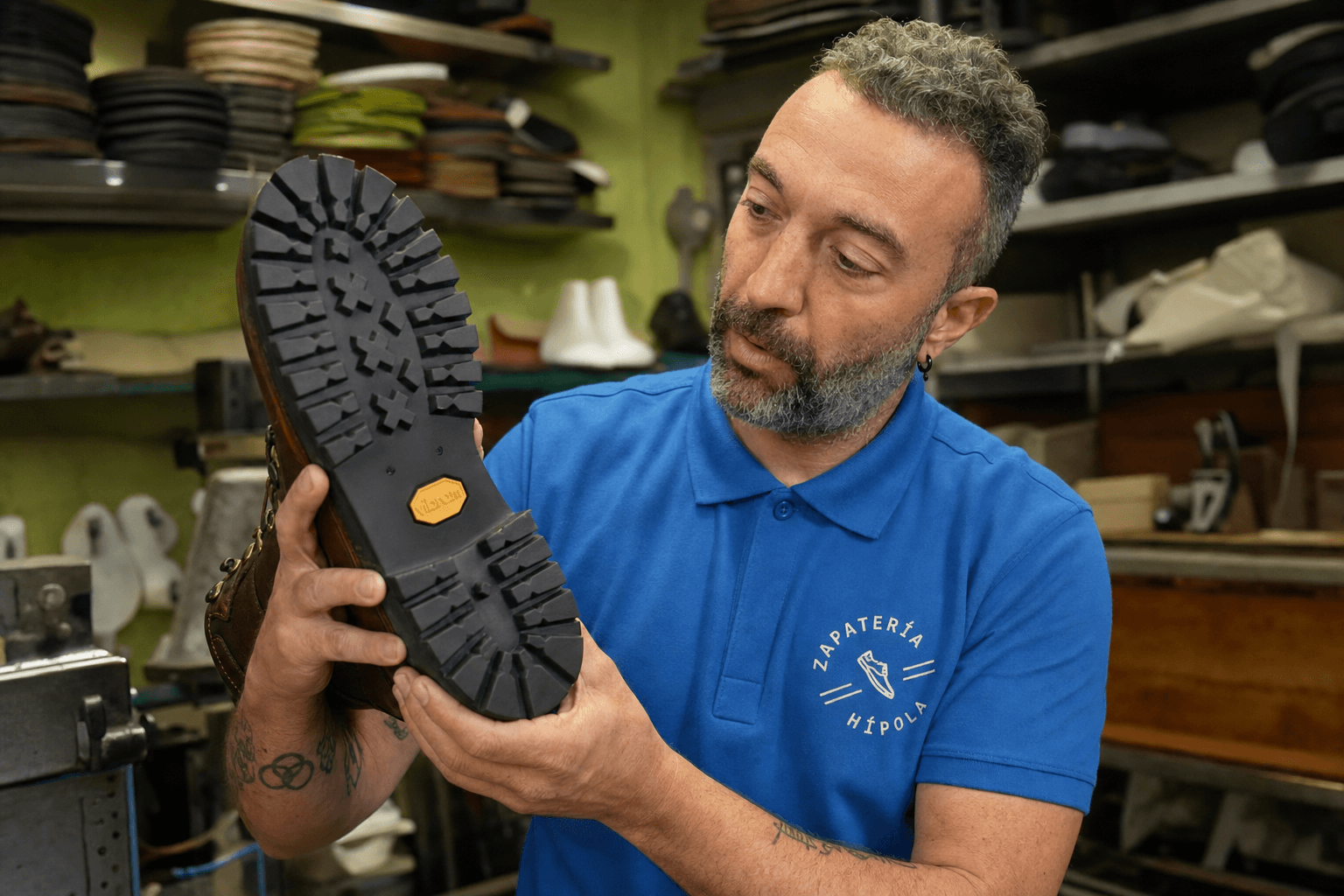
Full resole in the workshop: €65. That covers a new Vibram outsole, bonding with the Pegafort system, side re-stitching where needed and a full check of the upper.
New mountain boots: €150 to €300 in the mid and upper range. You can pay less than €100, but what they take and how they hold your ankle drops with the price.
How long a properly fitted outsole lasts: as long as the factory one, provided the rest of the boot keeps up. A decent leather boot takes more than one resole in its lifetime.
And something a new boot does not come with: the outsole-to-upper bond we make with the Pegafort system carries a lifetime guarantee. If the bond fails, barring an extreme knock or unreasonable use, re-bonding costs you nothing.
The part that decides: the midsole
Between the upper (the part wrapped around your foot) and the outsole you walk on there is a middle layer: the midsole. On most trekking and mountain boots it is polyurethane.
Polyurethane doesn't wear out from walking. It breaks down over time, with damp and with the heat of a storage cupboard. It is called hydrolysis, and it is why boots stored for eight or ten years, spotless on the outside, fall apart on the first hike.
How to check it at home
Press the side of the midsole with your thumb, the strip between the leather and the lugs. Firm and springing back is good. Sinking in without recovering, cracking in fine lines or leaving dust on your thumb is hydrolysis.
And here is the honest part: if the midsole is gone, a new outsole does not fix the boot. It would peel off again within a few outings. We tell you before touching anything, and looking costs you nothing.
When resoling does pay off
✅ The upper is sound. That is the expensive part of a boot: the leather, the stitching, the lining, the membrane. If it is holding up and you bin the boot, you are throwing away the valuable half to avoid paying for the cheap one.
✅ The midsole is firm. No cracks, no crumbling, still springy to the touch.
✅ The boot is properly yours. It has moulded to your foot and you know it doesn't rub. That doesn't come in a new box.
✅ It was an expensive boot. Retiring a €250 pair to avoid paying €65 doesn't add up in any currency.
✅ It is a classic mountain boot. They are built for exactly this: outsole gets replaced, boot carries on.
When we will tell you not to
❌ The leather is dry and split along the flex creases, or the fabric opens up when you pull it with two fingers. The new outsole would outlive the rest of the boot.
❌ The midsole has hydrolysed. The number one reason we say no.
❌ It was a €60 or €80 boot. The resole gets too close to the price of the whole boot.
❌ It never fitted you. If it has hurt since day one, resoling just extends the problem by another year.
The two options side by side
This is what actually changes between resoling and replacing, beyond the price:
| Resole in the workshop | Buy a new pair | |
|---|---|---|
| What you pay | €65 for the full resole | €150 to €300 mid to upper range |
| What gets renewed | Outsole, bond and stitching | Everything, including what was still fine |
| Breaking in | None, it is the same boot as always | Two or three outings until it gives |
| Turnaround | 5 to 10 working days in the workshop | However long it takes you to pick right |
| When it doesn't work | If the midsole has gone | It always works, it just costs 3 or 4 times more |
What the price doesn't show
A resoled boot leaves the workshop already broken in. A new boot asks you for two or three outings of breaking in, and those outings have a cost that isn't on the label: blisters, half a weekend written off, or walking up thinking about your feet instead of the path.
Then there is the materials side. Resoling reuses the leather, the lining and the structure you already own, and changes only the rubber and the adhesive. We won't give you the full green sermon, but if the money works out even, this is what breaks the tie.
Which outsole we fit
There is no such thing as the Vibram outsole, there are dozens, and a boot for tracks and trails is not the same as one for via ferrata or for crampons. We pick it by where you walk, how much weight you carry and how the old outsole has worn, which tells us more than you would think.
If you want the detail on each compound and each lug pattern, it is all in how to choose the Vibram sole for your boots.
How we decide in the workshop
1. Send us three photos on WhatsApp: the outsole, the side of the whole boot and the inside.
2. We tell you whether it can be fixed, with which outsole and what it costs. Fixed quote, free and with no commitment.
3. If the boot isn't worth it, we say so anyway. We would rather lose the job than charge you €65 for something that will break again.
4. If you live outside Madrid there is no need to come: with nationwide pick-up it is €18 round trip on the mainland, the courier calls at your home and the price is fixed on WhatsApp before you send anything.